How a Rally Is Scored
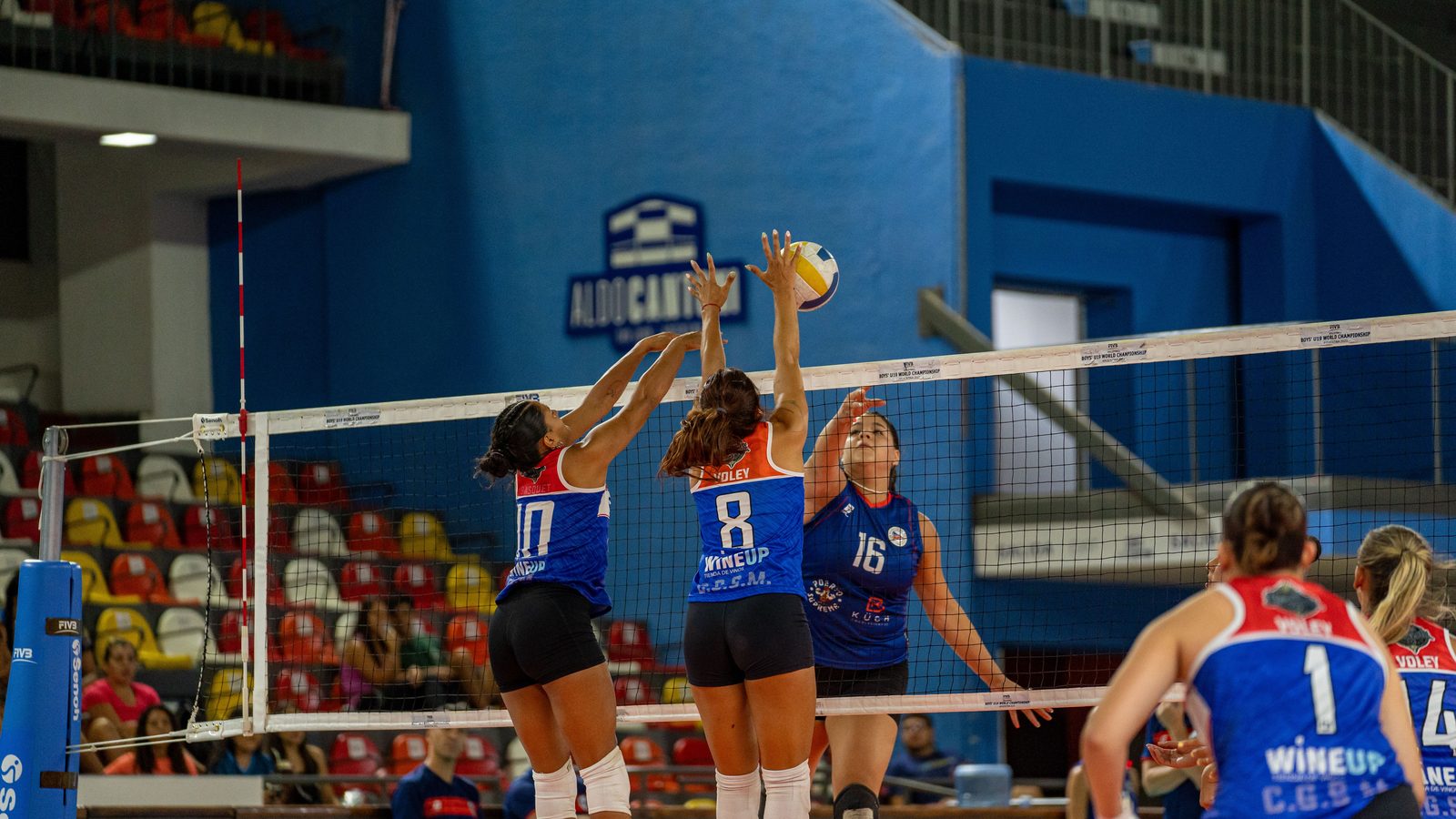
Here is the single most useful thing a new volleyball fan can know: every rally ends with a point for somebody. Not just the serving team. Not just the team that “earned” it. Somebody. Every time.
That one idea explains the pace of the sport, the roar after a long rally, the groan after a missed serve, and why a coach can look so calm down 20–17. Volleyball is a sprint of tiny verdicts, and the scoreboard records every one of them.
This guide walks through how scoring works in NCAA women’s volleyball: how long a set lasts, why it has to be won by two, who serves next, what a “side-out” is, every way a rally can end, and how all of it shows up in the box score. It is a teaching page, not a rules ruling.
Primary source: 2026 and 2027 NCAA Women’s Volleyball Rules and Interpretations (PDF), linked from the NCAA Women’s Volleyball Playing Rules hub. Rule numbers below cite that book. For box-score language: NCAA Official Volleyball Statistics Rules (2022 PDF) and the NCAA.com college volleyball dictionary.
Related: Volleyball points explained · How to read a box score · Hitting percentage explained · Libero position guide · Setter position guide · Defensive specialist position guide · Serve receive for new watchers
The whole thing on one napkin
| Question | Answer | Rule |
|---|---|---|
| Who gets a point? | The team that wins the rally, whether it served or not | 8.1.2, 8.1.3.1 |
| How long is a set? | First to 25, but you must lead by two | 8.2.1 |
| What if it’s 24–24? | Keep playing until someone leads by two | 8.2.1 |
| Is there a cap? | No. 31–29 is legal. So is longer. | 8.2.3 |
| How many sets? | Best three out of five. First to win three sets wins the match. | 8.4.1 |
| The fifth set? | The deciding set goes to 15, still win by two | 8.2.2 |
| Who serves next? | Whoever just won the rally | 8.1.3.1.1–8.1.3.1.2 |
That is the entire scoring system. Everything else on this page is the delicious detail.
Every rally is a point
Rule 8.1.2 is wonderfully blunt. A team scores a point when:
- The ball contacts the opponent’s court (Rule 8.1.2.1),
- The opponent commits a fault (Rule 8.1.2.2), or
- The opponent is assessed a penalty, or an opposing team member is disqualified (Rule 8.1.2.3).
A rally starts with the first referee’s whistle to authorize the serve and ends when the ball is out of play. It is “completed” when a point is awarded to either team (Rule 8.1.3.1).
You will hear this called rally scoring. That phrase isn’t in the rules book; it is simply what everyone calls a system where every rally pays out. If you grew up hearing that only the serving team could score in volleyball, that was an older way of keeping score. Under the current NCAA book, the serve is not a requirement for scoring. It is just the opening line of the argument.
Sets: 25, win by two, no ceiling
A non-deciding set (sets one through four) is won by the first team to 25 points with at least a two-point lead. At 24–24, play continues until one team leads by two (Rule 8.2.1). There is no point cap on any set (Rule 8.2.3).
That last line is where legends are born. A set can sail past 25 and keep going, each side trading points, until someone finally strings two together. If you have ever seen a gym hold its breath at 28–28, this is why.
The match: best of five, and the fifth set is a sprint
All NCAA matches are the best three out of five sets; the first team to win three sets wins the match (Rule 8.4.1). That means a match can end 3–0 (a sweep), 3–1, or 3–2.
If it goes to a fifth set, the deciding set is played to 15, again with at least a two-point lead (Rule 8.2.2). A 15-point set is a short story with no room for a slow chapter. Two shaky serve-receive turns can decide a season’s worth of bragging rights.
A few match-rhythm details worth knowing:
- Between sets: a maximum interval of three minutes, unless the host uses the optional intermission of no more than five minutes between sets two and three (Rules 8.4.2, 8.4.2.4).
- Who serves first: the visiting team calls the prematch coin toss, and the winner chooses to serve or receive in the first set (Rule 9.1.3). In the other non-deciding sets, the team that did not serve first in the previous set serves first (Rule 13.1.2).
- The fifth-set toss: there’s a second coin toss before a deciding set; the home team calls it, and the winner picks serve/receive or side of the court (Rules 9.2.4.4.1–9.2.4.4.2).
- Changing sides: teams change sides at the end of the second set. In a fifth set, teams stay on their side for the whole set; there is no mid-set switch (Rule 9.2.4, flagged as a 2026 change in the book).
Who serves after a point
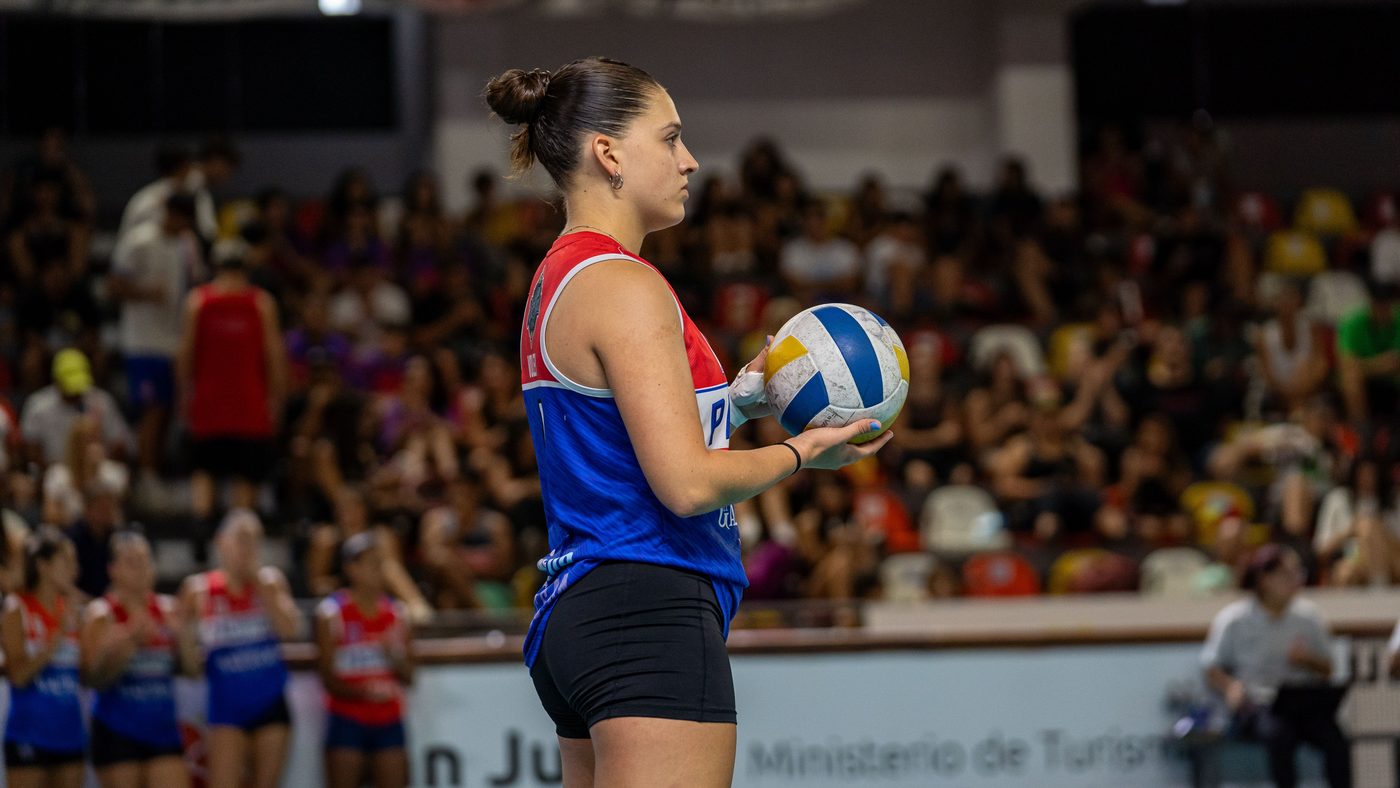
This is the part that rewires new fans’ brains, so let’s go slowly.
- If the serving team wins the rally, it scores a point and keeps serving, with the same server (Rule 8.1.3.1.1). Her turn at the line, called the term of service, lasts until her team loses a rally or the set ends (Rule 13.1.4).
- If the receiving team wins the rally, it scores a point and earns the serve. Before serving, its players rotate one position clockwise (Rules 8.1.3.1.2, 10.2.2).
That second scenario has a name. The NCAA.com dictionary calls it a side-out: the serving team fails to score, the receiving team wins the rally (or the server’s team makes an error), and the serve switches sides. “Side-out” is fan and coach vocabulary, not rules-book vocabulary, but you will hear it on every broadcast. Broadcasters and coaches talk about siding out constantly, and for good reason: a team that can’t win rallies on the other team’s serve is in for a long night.
So the beat of a set is: serve, rally, point, and either the same server again or a side-out and a rotation.
Rotation, in plain English
Six players are on the court for each team at the start of every rally: three in the front row (positions 4, 3, and 2, left to right) and three in the back row (positions 5, 6, and 1) (Rule 10.2.1). Position 1 is back right, and that’s where the server comes from (Rule 13.1.1).
When a team wins the serve back, everyone shifts one spot clockwise. The player in position 2 moves to position 1 and serves; the player in position 1 slides to 6; and so on (Rule 10.2.2). The rotation order set by the starting lineup must hold for the entire set (Rule 10.2).
Why this matters for scoring:
- Everyone serves eventually. Rotation is why a team’s best server can’t simply stay at the line forever. She keeps serving only as long as her team keeps winning rallies.
- Everyone visits the front row eventually. Hitters rotate to the back row, where their attacking is limited (Rule 14.5.4). That’s when coaches send in a libero or a defensive specialist.
- Your setter’s spot matters. Broadcasters will say “rotation 1” or “the setter’s in the front row.” They’re telling you which three attackers are available at the net right now.
- Being out of position costs a point. If players aren’t in their correct positions when the server contacts the ball, it’s a position fault, penalized with loss of rally (Rules 10.3.2, 10.3.2.2). Serving out of order is a rotation fault, also loss of rally, and points scored under the wrong server can be canceled (Rules 13.2.3, 13.2.3.2). Once the ball is served, players can move anywhere (Rule 10.3.1.2).
Every way a rally ends
Every rally ends with one team either putting the ball down or making a mistake. Here is the menu, translated from the rules book.
Somebody puts it away
| How it ends | What happened | Rule |
|---|---|---|
| Ball lands in | The ball touches the floor of the opponent’s court, lines included | 8.1.2.1, 16.2.1 |
| Kill | An attack the other team can’t return; the ball goes down or can’t be kept in play | 8.1.2.1 (scored as K in the box score) |
| Ace | A serve the receiving team can’t handle | 8.1.2.1 (scored as SA) |
| Block | A front-row blocker deflects the attack back down onto the hitter’s side | 14.6.1, 14.6.1.2 |
Somebody makes a mistake
| Fault | What it means | Rule |
|---|---|---|
| Ball out | It lands outside the lines; hits a wall, an object above a non-playing area, or a person out of play; or touches the antenna, the net outside it, the net post, or the referee’s stand | 16.2.2.1–16.2.2.5 |
| Service error | The serve doesn’t clear the net through the legal crossing space, goes under it, touches a serving teammate, lands out, or passes over a screen | 13.2.1.1 |
| Illegal serve | Foot on the end line or court at contact, throwing the ball, two-handed serve, wrong server, a toss that drops untouched, or more than eight seconds after the whistle | 13.1.3.3, 13.2.2.1 |
| Four hits | A team gets three contacts to send it back (a block touch doesn’t count as one); a fourth is a fault | 14.1.1, 14.4.1, 14.6.2.1 |
| Ball-handling | A caught, thrown, or prolonged contact; or a double contact on a second hit that goes over or on a third hit | 14.2.2, 14.4.3, 14.4.4 |
| Net fault | Touching the net or antenna while playing the ball, or in a way that interferes with play | 15.2.1 |
| Center line | Completely crossing the center line and touching the opponent’s court with one or both feet | 15.2.4.3 |
| Reaching over | Contacting the ball or an opponent over the opponent’s side before or during their attack | 15.1.3.3 |
| Illegal back-row attack | A back-row player in the front zone completes an attack while the ball is entirely above the net | 14.5.4.1 |
| Illegal block | A back-row player or libero takes part in a completed block, or anyone blocks the serve | 14.6.1.3, 14.6.6 |
| Attacking the serve | Hitting the opponent’s serve back from the front zone while it’s entirely above the net | 14.5.2 |
| Position or rotation fault | Someone is out of place at the serve, or the wrong player serves | 10.3.2, 13.2.3 |
| Penalty | A red card for misconduct means loss of rally and a point for the opponent | 6.1.2.2, 8.1.2.3 |
A few quiet subtleties that settle bleacher debates:
- The ball can touch the net and still be good, including on a serve (Rules 15.1.2.1, 13.2.1.1.3).
- The first contact gets some grace. Successive contacts in one attempt are allowed on the team’s first hit, and on a second hit if a teammate plays it next; on a third hit they’re a fault (Rule 14.2.3; see the book’s Ball Handling Judgment Guidelines).
- A double fault is a do-over. If opponents commit faults at the same time, nobody scores; the rally is replayed (Rule 8.1.1).
- The whistle ends it. If the whistle is for a fault, the ball is out of play from the moment of the fault (Rule 16.1.2).
What’s new in the 2026–27 book that touches scoring
The rules book flags its changes for 2026 and 2027. The ones a fan will notice in the points column:
- Center-line faults are simpler. Completely crossing the center line and touching the opponent’s court with one or both feet is now a fault, period (Rule 15.2.4.3). Officials no longer have to judge whether it created a safety issue.
- No hands up while your team serves. Serving-team players may not raise their hands above their heads until the serve has crossed the net (Rule 13.2.4). It’s part of the screening rule, so it ties into the service-error list above.
- Center-line challenges. Coaches may now challenge whether an opponent’s foot completely crossed the center line, and reviewers may also look for net faults on the same play (Rule 18.1.4.7).
- Score mistakes can be fixed. The book now defines a scoring discrepancy: the official scoresheet is the controlling record, and referees can correct a scoring error without a coach’s protest, using the stats crew or video review where available (Rules 8.1.4.1–8.1.4.3).
- Optional technical timeouts. When a conference or host uses them, a technical timeout comes when a team reaches 15 points in sets one through four, never in the fifth (Rule 11.2.4.1).
Timeouts and challenges: pauses, not points
Two more things you’ll see between rallies. Neither scores a point by itself, but both can change who wins the next one.
- Team timeouts: each team gets up to two per set, 75 seconds by default (Rules 11.2.1.1, 11.2.2.1). If a broadcast uses media timeouts instead, one comes when the first team reaches 15 points (8 in a deciding set), unless a team timeout has already been taken (Rule 11.2.3.1). A match uses media or technical timeouts, not both (Rule 11.2.1.3).
- Video challenges: the Challenge Review System is optional; schools and conferences may use it but are not required to (Rule 18.1.2). Where it’s in use, each team starts the match with two challenges, and if a fifth set is played each team gets one more, up to two total (Rules 18.1.5.1–18.1.5.1.1). Only the head coach can ask, by forming a “C” with their hands, and only the team that lost the rally can challenge (Rules 18.1.5.3–18.1.5.4). Win the review and you keep the challenge; lose it and it’s gone (Rule 18.1.5.8). Reviewable calls include in/out, touches, net faults, service foot faults, back-row attacks, and the new center-line call (Rule 18.1.4). If the video is inconclusive, the call on the floor stands (Rule 18.1.1.3).
Want the full mechanics of who can check in and when? Read Substitutions, Explained.
How points show up in the box score
The scoreboard tells you who won the rally. The box score tries to tell you how. The NCAA statistics manual gives every ending a label.
| Rally ended because… | Box score credit | Stats manual |
|---|---|---|
| An attack went down or couldn’t be returned | K (kill) to the attacker | Sec. 1, Art. 2 |
| The hitter hit out, into the net, got blocked down, or was called for a net, center-line, antenna, back-row, or contact fault on the swing | E (attack error) to the attacker | Sec. 1, Art. 3 |
| A serve couldn’t be handled | SA (ace) to the server, RE (reception error) to the passer | Sec. 3, Arts. 2, 5 |
| A serve missed, foot-faulted, took too long, or came from the wrong server | SE (service error) to the server | Sec. 3, Art. 3 |
| One player blocked it down for a point | BS (block solo) | Sec. 5, Art. 2 |
| Two or three players blocked it down for a point | BA (block assist) to each | Sec. 5, Art. 3 |
| A double hit, thrown, or lifted ball outside of serve receive or an attack | BHE (ball-handling error) | Sec. 4, Arts. 2–3 |
| A blocker hit the net, crossed the line, reached over, or blocked from the back row | BE (blocking error), and the attacker gets a kill | Sec. 5, Arts. 4–5 |
Three cross-checks the manual itself suggests, and they make box scores far less mysterious:
- Aces and reception errors mirror each other. One team’s service aces must equal the other team’s reception errors (Statistics Accuracy Check 1).
- Individual points use a formula. PTS = kills + aces + block solos + half of block assists (Sec. 6, Art. 7). More on that in Volleyball points explained.
- Team blocks count assists as halves. A team’s block total is block solos plus half of block assists, so two players sharing one stuff count as one team block (Accuracy Check 4).
And here’s the twist every new fan should learn early: not every point on the scoreboard belongs to a player on the scoring team. When an opponent misses a serve, gets called for a double contact, or touches the net, your team gets the point, but nobody on your side gets an individual stat for it. That’s why adding up one team’s kills, aces, and blocks almost never matches its score.
A labeled example (invented numbers)
EXAMPLE ONLY: not a real team, match, or player. Say a team wins a set 25–21. One way its 25 points could break down:
| Source | Points |
|---|---|
| Kills | 13 |
| Service aces | 2 |
| Team blocks (1 block solo + 4 block assists → 1 + 4 × ½) | 3 |
| Opponent errors with no stat for the scoring team (say, 4 service errors, 2 attacks hit out, 1 net fault) | 7 |
| Total | 25 |
One caution about the math: when an opponent’s attack is blocked, the hitter gets an attack error and the blockers get the block. Count that point once, in the blocks row, not twice.
And one EXAMPLE player line, also invented, to show the PTS formula at work:
| Player | K | E | TA | SA | BS | BA | PTS |
|---|---|---|---|---|---|---|---|
| Example Player | 4 | 1 | 10 | 1 | 0 | 2 | 6.0 |
That’s 4 kills + 1 ace + 0 solos + (2 × ½) = 6.0. Her hitting percentage is (4 − 1) ÷ 10 = .300. That formula gets its own page: Hitting percentage explained. For every column on a real box, see How to read a box score.
Digs, blocks, and aces get the full treatment in Digs, blocks, and aces.
Your first match: a five-minute watching plan
- Watch the server, then the scoreboard. Same server back at the line? Her team won the point. New server on the other side? That was a side-out.
- Count to 25, then count the gap. At 24–23, the leader is one rally from the set. At 24–24, nobody is.
- Find the libero and the setter. The libero’s contrasting jersey tells you who’s passing; the setter’s spot tells you who can attack. Our libero and setter guides help.
- Ask “earned or given?” After each point, decide: kill, ace, or block (earned) or an error (given). By the end of a set, you’ll know why the score looks the way it does.
- Check the box after. Match your gut against the K, E, SA, SE, and block columns. You’ll be surprised how often the “given” points decided it.
Sources
- 2026 and 2027 NCAA Women’s Volleyball Rules and Interpretations (PDF). Major Rules Changes for 2026 and 2027; Rules 6.1.2.2 (penalty), 8.1 (faults, scoring, rally, score discrepancy), 8.2 (winning score, no cap), 8.4 (best of five, intervals), 9.1.3 and 9.2.4 (coin tosses, changing sides), 10.2–10.3 (rotation, positions, position faults), 11.2 (timeouts), 13 (service, serving faults, rotation faults, screening), 14 (playing the ball, attack, block), 15 (net, center line), 16 (ball in/out, ball out of play), 18 (Challenge Review System).
- NCAA Women’s Volleyball Playing Rules hub
- NCAA Official Volleyball Statistics Rules (2022 PDF): kills, attack errors, service aces and errors, reception errors, ball-handling errors, blocks, blocking errors, points per set, and the statistics accuracy checks.
- College volleyball dictionary — NCAA.com: side out, rally, rotation, kill, service ace.
Rules change on a two-year cycle, and interpretations can arrive mid-season. Before you settle a bleacher argument with a rule number, check the current book on the NCAA playing rules hub.