Digs, Blocks, and Aces
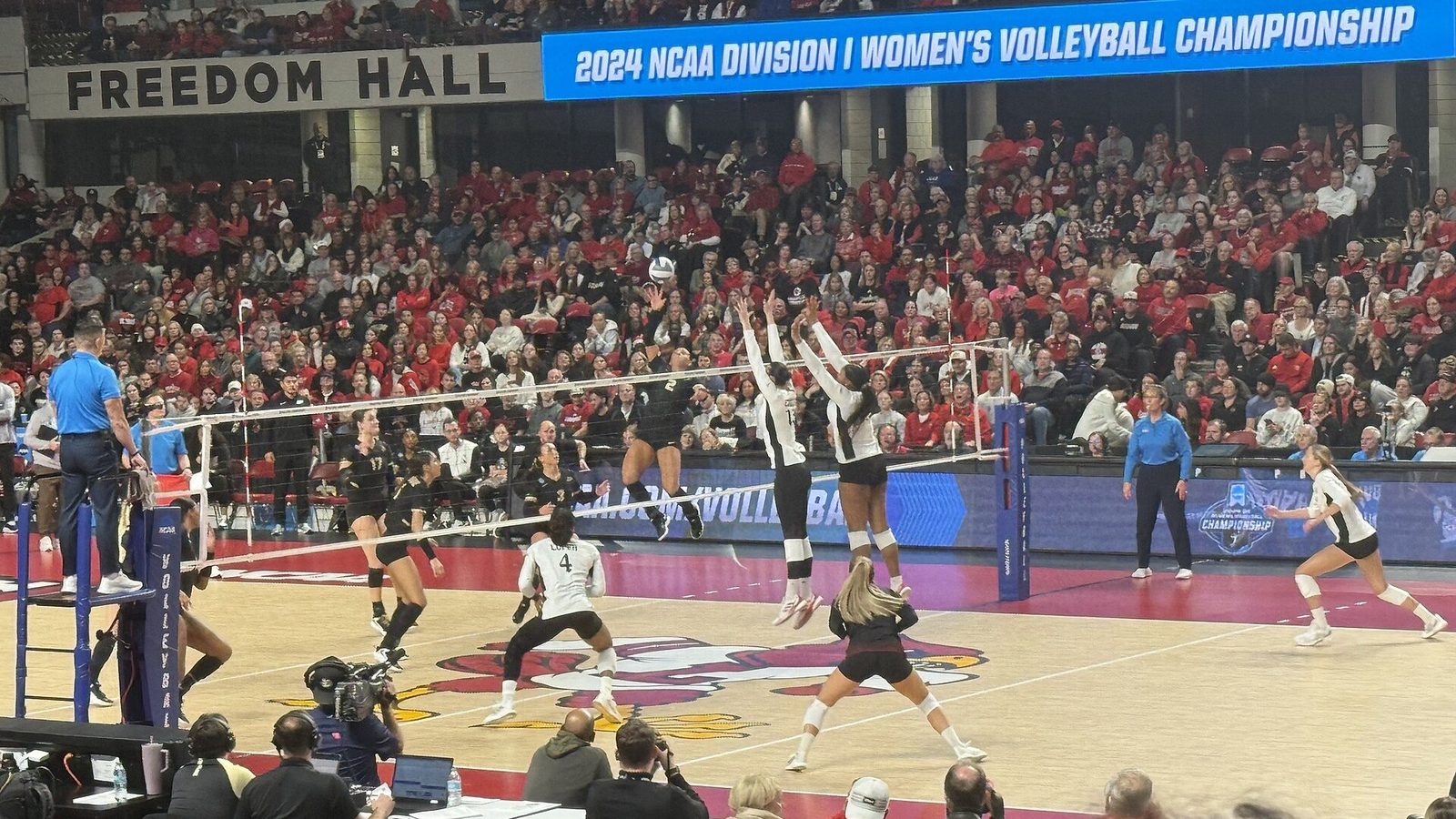
Kills get the highlight reels. Fair enough; they’re loud. But a volleyball match is mostly decided in three quieter places: the serve that nobody touched, the arms that went up at the net, and the forearms that scraped a heavy swing off the hardwood.
Those are aces, blocks, and digs, and they each have a precise, slightly surprising definition in the NCAA’s official statistics rules. A ball that pops off a blocker’s fingers and stays in play? Not a block. Not a dig either. A serve that the passer touches but shanks into the bleachers? Ace. A setter’s sneaky dump that the libero pops up? That’s a dig.
This guide teaches the three stats the way the official scorer counts them, links each one to the playing rules behind it, and shows how they turn into the numbers you see on a box score and in national leaderboards.
Primary sources: NCAA Official Volleyball Statistics Rules (2022 PDF) for how stats are credited, and the 2026 and 2027 NCAA Women’s Volleyball Rules and Interpretations (PDF) for what’s legal on the court. “Stats” citations below point to the 2022 manual’s sections; “Rule” citations point to the 2026–27 rules book.
Related: How a rally is scored · How to read a box score · Volleyball points explained · Hitting percentage explained · Libero position guide · Middle blocker position guide · Defensive specialist position guide · Serve receive for new watchers
The cheat sheet
| Stat | Box score | Counts when | Doesn’t count when | Per-set stat |
|---|---|---|---|---|
| Service ace | SA | A serve leads directly to a point | The receiving team keeps the ball in play | Aces per set = aces ÷ sets |
| Service error | SE | The serve is missed, illegal, or out of rotation | The serve is legal and in | (not a per-set leader stat) |
| Dig | DIG or D | A player passes an attacked ball and it’s kept in play | The ball came off a block, or nobody could keep it alive | Digs per set = digs ÷ sets |
| Block solo | BS | One blocker, alone, puts an attack down for a point | Anyone else was blocking with her | Individual blocks per set = (BS + BA) ÷ sets |
| Block assist | BA | Two or three blockers put an attack down for a point | The ball deflects and stays in play | Team blocks = BS + ½ BA |
| Blocking error | BE | The referee whistles a blocker for a fault | The ball simply goes off the block for a kill | (charged, not ranked) |
Formulas from Stats Section 6, Articles 3–5. Definitions from Stats Sections 3–5.
Aces: the point nobody else touched (much)
A service ace (SA) is “a serve that results directly in a point” (Stats Section 3, Article 2). The manual lists four ways to earn one:
- The serve hits the opponent’s court untouched.
- The serve is passed by the opponent but can’t be kept in play.
- The referee calls a violation on the receiver, such as a lift or a double hit.
- The receiving team is out of rotation (an overlap).
That second item settles one of the great bleacher arguments. “She touched it, so it’s not an ace.” Wrong. If the passer gets a piece of it and the ball dies, the server gets the ace.
Every serve has exactly three possible outcomes: an ace, a service error, or a zero serve, meaning play simply continues (Stats Section 3, Article 1). A zero serve is the everyday case: nobody gets a stat, and the rally rolls on.
What counts as a service error
The server is charged a service error (SE) when the serve fails to clear the net and lands on her own side, sails out or hits the antenna, she foot-faults or takes too much time, or she tosses more than once (Stats Section 3, Article 3). The playing rules behind those: serving faults in Rule 13.2.1, illegal service in Rule 13.2.2, the eight-second clock in Rule 13.1.3.3, and the one-toss limit in Rule 13.1.3.4.
Two oddities worth knowing:
- Serving out of rotation: the error goes to the player who should have been serving, not the one who did (Stats Section 3, Article 3, and its A.R. 4).
- Her teammate overlapped: if the server is in rotation but a teammate is called for being out of position, the error is still charged to the server (Stats Section 3, Article 3).
New for 2026–27: players on the serving team may not raise their hands above their heads during the serve until the ball crosses the net (Rule 13.2.4, the screening rule). That’s a rule about what teammates do, not a new stat, but it’s one more way a serve can cost you the rally.
Every ace has a mirror
Here’s a lovely bit of bookkeeping. When one team gets an ace, the other team gets a reception error (RE) (Stats Section 3, Article 7). If the statistician can’t tell which passer was responsible, say the ball drops between two players, or the receiving team was out of rotation, it’s logged as a team reception error instead (Stats Section 3, Article 6).
So on any correct box score, Team A’s aces equal Team B’s reception errors, team errors included. That’s the first item on the NCAA’s own accuracy checklist. If they don’t match, the box is wrong.
A reception error is charged only when an ace happens. A bad pass that a teammate saves is not a reception error, even if the rally goes sideways from there (Stats Section 3, A.R. 2 and A.R. 3).
Two rules about defending a serve
- You can’t block a serve. It’s a fault (Rule 14.6.6).
- You can’t attack a serve while the ball is in the front zone and entirely above the top of the net (Rule 14.5.2).
That’s why passers have to play the serve with their forearms or hands and work it to the setter. The serve gets a free trip over.
The serving trade-off
Watch any match and you’ll see servers making a choice: hit a tough serve that might be an ace or might sail long, or a safer one that just starts the rally. Because the same aggressive swing can produce either result, the smart read on a server’s night is the SA and SE columns side by side, never aces alone.
Digs: keeping an attacked ball alive
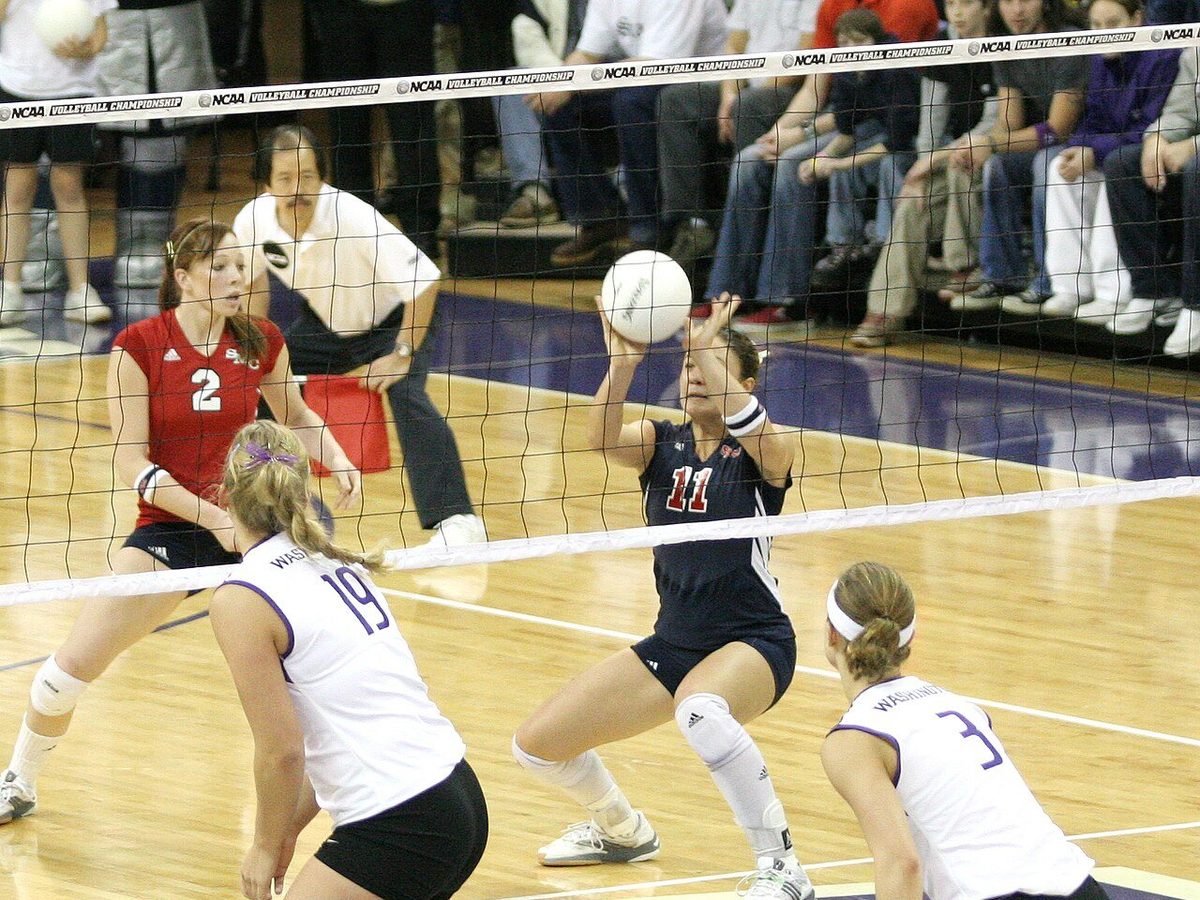
A dig (D) is awarded “when a player passes the ball that has been attacked by the opposition” (Stats Section 4, Article 1). The ball has to be kept in play. Then comes the manual’s philosophy line, which is worth memorizing:
The pass or play of any ball that is attacked is awarded a dig. The ball can be kept in play on the digger’s side of the net or can go back to the opposition. In either case, a dig is awarded.
So a dig doesn’t have to be pretty, and it doesn’t have to lead to a counterattack. If she keeps an attacked ball alive, it’s a dig.
What is not a dig
- A serve receive. A serve isn’t an attack. The rules define an attack-hit as any action “other than a block or a serve” that sends the ball toward the opponent (Rule 14.5.1). Passing a serve shows up in the reception columns, never as a dig.
- A ball off a block. If your team’s block knocks the ball back to the attacking team and they play it, that’s a “put back,” and nobody gets a dig (Stats Section 4, Article 1, and Section 5, A.R. 2).
- A save nobody can finish. If the defender touches the attack but her team can’t keep the ball in play, no dig (Stats Section 4, A.R. 1).
- A ball off your own teammate’s block attempt. If the attack deflects off a blocker and a teammate then keeps it alive, the teammate gets the dig and the blocker gets nothing (Stats Section 4, A.R. 2).
And one that surprises people: when a setter dumps or aggressively sets the ball over and the defender keeps it in play, the setter is charged an attack attempt and the defender gets a dig (Stats Section 4, A.R. 4). An attack is an attack, no matter who threw it.
Who digs
Digs pile up in the back row, which is why the libero and defensive specialists usually lead teams in this column. Outside hitters who play all six rotations rack them up too; see the outside hitter guide.
The ceiling on digs
The NCAA accuracy check puts a hard cap on digs: a team’s total digs can’t exceed the number of opponent attacks that stayed in play (“zero attacks”) (Stats, Statistics Accuracy Check, item 6). Every kill and every attack error removes a dig opportunity. That’s a useful lens: a team with sky-high digs is often facing a lot of swings that don’t end the rally, which says something about both the defense and the hitters on the other side.
Blocks: points made at the net
Start with the playing rules. Blocking is a player close to the net deflecting the ball coming from the opponent by reaching higher than the top of the net (Rule 14.6.1). A few rules shape everything that follows:
- Only front-row players can complete a block (Rule 14.6.1.2). A back-row player or libero who takes part in a completed block commits a fault (Rule 14.6.1.3).
- The libero may not block or even attempt to block (Rule 12.1.2.2).
- A block touch isn’t one of your three hits. After a block contact, a team still gets three hits to return the ball (Rule 14.6.2.1), and the blocker can take the very next touch (Rule 14.6.2.2).
- An attempt isn’t a block. Jumping without touching the ball is a block attempt (Rule 14.6.1.1).
Now the stat. A block is credited only when the block leads directly to a point (Stats Section 5, Article 1). Every block attempt ends one of three ways: a block solo or block assists, a blocking error, or the ball deflects and stays in play.
Block solo vs. block assist
- Block solo (BS): a single player blocks the ball into the opponent’s court for a point, and she has to be the only blocker attempting to block it (Stats Section 5, Article 2).
- Block assist (BA): two or three players block the ball down for a point. Each blocker gets a block assist, even if only one of them touched the ball (Stats Section 5, Article 3).
You can’t have both on one play (Stats Section 5, Article 3 note). What if two blockers jump a few feet apart and only one gets a hand on it? The statistician decides whether they were covering overlapping space and working together. If so, assists for both. If not, a solo (Stats Section 5, A.R. 3).
The half-point math
This is where blocks get interesting. On the individual line, a block solo and a block assist each count as one block. For the team, two assists on one play are one point, so:
- Individual blocks = BS + BA
- Team blocks = BS + ½ BA
That’s Stats Section 6, Article 5 and accuracy check item 4. It’s why a team’s block total is often a decimal-looking number that’s smaller than the sum of its players’ blocks. A team’s total blocks also can’t exceed the opponent’s hitting errors (accuracy check item 3), because every block is also an attack error on the other side.
Blocking errors
A blocking error (BE) is a referee’s call that ends the rally (Stats Section 5, Article 4). It’s charged when a blocker goes into the net, commits a center-line fault, reaches over the net illegally, is a back-row player caught blocking, or is called for a thrown ball while blocking (Stats Section 5, Article 5). When that happens, the attacker gets a kill (Stats Section 5, Article 5 note).
What is not a blocking error: an attack that simply ricochets off the block and lands out of the defenders’ reach. The manual is explicit that statisticians shouldn’t judge blocking technique, so that’s a kill for the hitter and no penalty for the blocker (Stats Section 5, A.R. 4). Tooling the block is a skill, not a blocking mistake.
Who blocks
Middles do the heavy lifting, since they have to close on attacks from both pins and the middle. The middle blocker guide covers that job, and the opposite hitter guide explains why the right-side player blocks the other team’s best outside attacker so often.
How these show up on a box score and in points
On a typical NCAA box score you’ll see SA, SE, and RE grouped as serving and passing, DIG on its own, and BS, BA, BE, and a total block column for blocking. Our box score guide walks every column.
The NCAA points formula uses two of these three stats:
PTS = kills + aces + block solos + ½ × block assists
That’s Stats Section 6, Article 7. Digs never score points in the stat book, because a dig keeps a rally going instead of ending it. That’s why the best defenders in the country can have spectacular nights that never show up in the points column. Volleyball points explained goes deeper.
Here’s an EXAMPLE line, invented to show the math, not a real player:
| Player | SA | SE | DIG | BS | BA | BE |
|---|---|---|---|---|---|---|
| Example Middle | 1 | 2 | 3 | 1 | 4 | 1 |
Her individual blocks are 1 + 4 = 5. Her contribution to team blocks is 1 + (4 × ½) = 3.0. Her points from serving and blocking are 1 ace + 1 solo + (4 × ½) = 4.0, before you add any kills. The 3 digs and the blocking error don’t change her points at all. If she played four sets, she’d be at 1.25 blocks per set (5 ÷ 4) and 0.25 aces per set (1 ÷ 4).
Five bleacher arguments, settled
| The play | The ruling | Source |
|---|---|---|
| The passer touches the serve but it shanks out of play | Ace for the server, reception error for the passer | Stats 3.2(2), 3.5(2) |
| A serve drops between two passers who both froze | Ace, charged as a team reception error | Stats 3.6, 3.A.R. 1 |
| An attack glances off the block and a defender keeps it alive | Dig for the defender, nothing for the blocker | Stats 4.A.R. 2 |
| Two blockers go up, only one touches it, ball goes straight down | Block assist for both | Stats 5.3, 5.A.R. 1 |
| The hitter tools the block and the ball lands out | Kill for the hitter, no blocking error | Stats 5.A.R. 4 |
See the real leaders
We don’t print made-up leaderboards. For actual national numbers:
- NCAA.com women’s volleyball stats (Division I) lists individual and team leaders in aces per set, digs per set, and blocks per set. Division II and III leaderboards are on the same site.
- Our Daily Desk follows the current season’s movers, and player search lets you look up any player across Divisions I, II, and III.
Sources
- NCAA Official Volleyball Statistics Rules (2022 PDF): Section 3 (serves, service aces, service errors, reception errors, team reception errors), Section 4 (digs, ball-handling errors), Section 5 (block solos, block assists, blocking errors), Section 6 (aces, digs, blocks, and points per set), and the Statistics Accuracy Check.
- 2026 and 2027 NCAA Women’s Volleyball Rules and Interpretations (PDF): Rules 12.1.2.2 (libero may not block), 13.1.3.3–13.1.3.4 (eight seconds, one toss), 13.2.1–13.2.2 (serving faults, illegal service), 13.2.4 (screening, a 2026 change), 14.5.1–14.5.2 (attack-hit, attacking the serve), and 14.6 (blocking).
- NCAA Women’s Volleyball Playing Rules hub
- NCAA.com women’s volleyball stats
The statistics manual linked from NCAA.org is the 2022 edition. Rules change on a two-year cycle, so check the NCAA playing rules hub for the current book before you settle a big argument with a rule number.