The JUCO Path into NCAA Volleyball
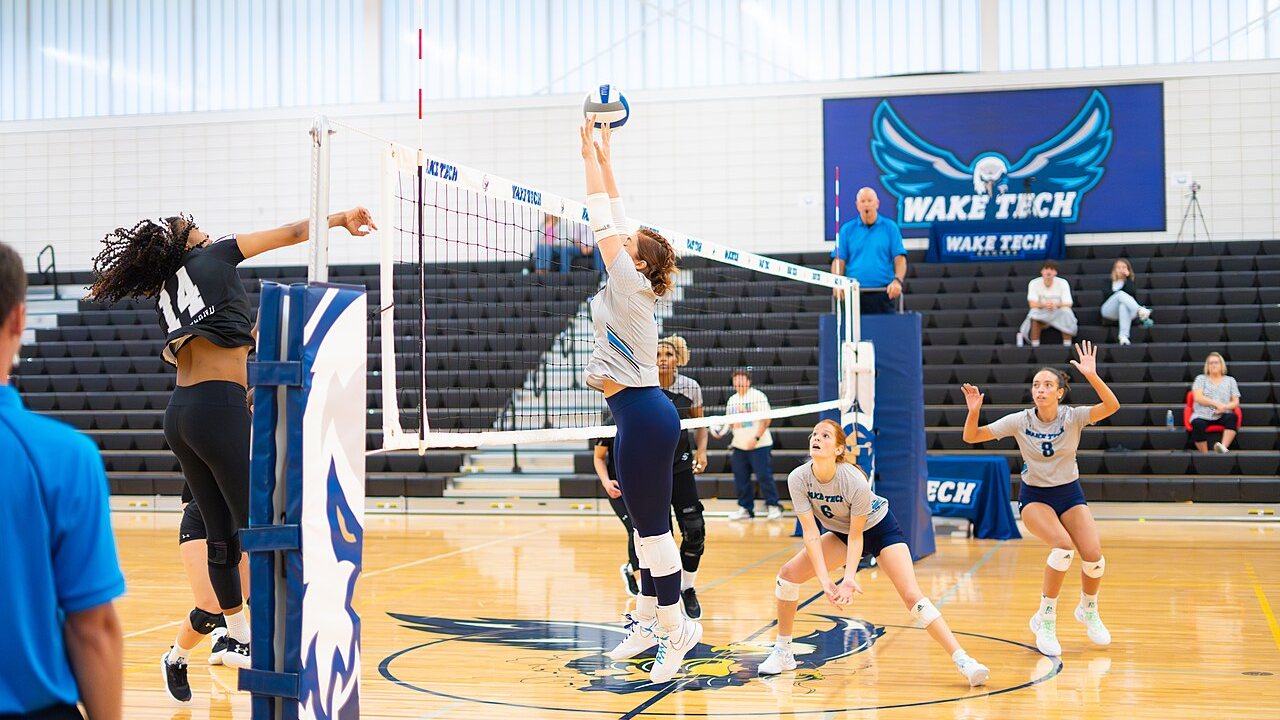
Junior college is not the consolation bracket. For a lot of players it is the smartest two years in their whole recruiting story: more reps, a fresh transcript, a coach whose job is to move you up, and a second shot at the offer that did not come in high school.
It is also a path with rules, and in 2026 those rules changed in the player’s favor. Here is the whole road on one page.
Primary sources: NCAA Eligibility Center Two-Year Transfer Guide (PDF), Division II 2-4 transfer flowchart (PDF), the May 2026 DI Academics and Eligibility Committee report (PDF), the Division I Cabinet report, June 23–24, 2026 (PDF), and Eligibility 101: age-based eligibility.
Not compliance advice. The compliance office at the four-year school certifies a transfer. Use this page to know which questions to bring.
Related: Transfer portal · Academic eligibility · Redshirt and medical hardship (2026 changes) · D1 vs D2 vs D3 · Scholarship types
Who plays two-year college volleyball
There is no single “JUCO.” Women’s volleyball at two-year colleges runs through three separate associations, each with its own rules:
| Association | Where | What to know |
|---|---|---|
| NJCAA | Nationwide | Three divisions. Per the NJCAA’s divisional structure, Division I schools may give full athletic scholarships (tuition, fees, books, room and board), Division II scholarships are limited to tuition, fees and books, and Division III schools may not offer athletic scholarships. Each sport has its own scholarship limit. |
| CCCAA | California community colleges | Its own association, eligibility code and state championship. Ask each program about aid before assuming. |
| NWAC | Washington, Oregon, Idaho and British Columbia | Its own association and championship. Same advice: get aid rules from the school in writing. |
The NJCAA’s 2026 season ends with three national championships, per its 2026 season preview:
- Division I: Nov. 18–21, Hutchinson Sports Arena, Hutchinson, Kansas
- Division II: Nov. 18–21, Alliant Energy Powerhouse, Cedar Rapids, Iowa
- Division III: Nov. 12–14, College of DuPage, Glen Ellyn, Illinois
Miami Dade, Heartland and Dallas College–Eastfield opened 2026 atop the NJCAA’s DI, DII and DIII preseason polls. Live results live on NJCAA Championships.
Why players choose it
The honest reasons, none of which require a hype video:
- Reps. A freshman who would sit behind a fifth-year at a four-year school can start, rotate all the way around and build film.
- A transcript reset, partly. Two-year college grades become the transfer GPA that four-year schools certify. It does not erase high school, but it gives a coach new evidence.
- Cost. Community college tuition is generally lower, and NJCAA DI and DII programs can add athletic aid. Get the actual offer from the school; do not assume full funding.
- Size and position development. Late-blooming middles and pins often need a year or two of strength and touches before a DI coach can see the ceiling.
The 2026 change: DI’s two-year transfer rules got simpler
In June 2026 the Division I Cabinet adopted Proposal No. 2026-40 as expedited legislation, effective immediately, revising the requirements for two-year college (2-4) and 4-2-4 transfers. The May 2026 DI Academics and Eligibility Committee report spells out what changed:
| Before 2026-40 | After 2026-40 (2026–27 and later) | |
|---|---|---|
| Transferable GPA | 2.500 | 2.000 |
| Average of 12 transferable hours per full-time term | Required | Eliminated |
| 48 semester / 72 quarter hours for nonqualifiers | Required | Eliminated |
| Extended term-of-residence rules | Applied in some cases | Removed in certain cases |
| Limit on PE activity credit | Yes | Kept |
| Core academic coursework (English, math, science) | Yes | Kept |
| Progress-toward-degree rules | Yes | Kept |
The committee wrote that the change applies to two-year and 4-2-4 transfers “seeking eligibility during the 2026-27 academic year and thereafter,” and that the immediate date lets athletes already serving a year of residence benefit right away.
One warning that matters: many NCAA flowcharts and school PDFs online still show the old 2.5 GPA and 48/72-hour language. They were accurate before June 2026. Ask the compliance office at the DI school recruiting you to walk your transcript through the current Bylaw 14 text, not a PDF from a past year.
What a DI 2-4 transfer still needs
Even under the simpler rules, the fundamentals carry over from the NCAA’s Two-Year Transfer Guide:
- Full-time terms count; summer school does not. The NCAA treats a player as a full-time two-year student by the regular term, not summer sessions.
- Transferable degree credit, not just any credit. Hours must transfer toward a degree at the four-year school. Remedial English and math do not satisfy the requirement.
- Core subjects. The transferable hours must include English, math and science coursework. The pre-2026 flowcharts listed six semester hours of English and three each of math and science; confirm the current figures with compliance.
- Your high school status still matters. Whether you were an initial-eligibility qualifier, academic redshirt or nonqualifier out of high school shapes which path applies. See Academic Eligibility.
- Progress toward degree at the four-year school kicks in once she arrives.
Division II: the 2.2 path
Division II did not adopt 2026-40; that was Division I legislation. DII’s own 2-4 transfer flowchart lays out the main routes for a player who never attended a four-year school full time:
| Situation | What she needs for immediate eligibility |
|---|---|
| Graduated from the two-year college | At least two full-time semesters or three quarters, at least 25% of the degree’s credit hours earned at the school awarding it, and at least nine transferable hours in the last full-time term |
| One full-time term only, a qualifier out of high school | At least 12 transferable hours that term, a 2.2 transferable GPA, and at least nine transferable hours in the last full-time term |
| More than one full-time term, not graduated | An average of 12 transferable hours per full-time term, a 2.2 transferable GPA, transferable English, math and science (six/three/three semester hours on the flowchart), and nine hours in the last full-time term |
Division II calls a recruit who fell short in high school a partial qualifier, not a nonqualifier. Per the DII 2025 Official Notice, a two-year transfer who misses the immediate-eligibility requirements may still practice and receive athletics aid, but not compete, during her first academic year in residence (effective for transfers on or after Aug. 1, 2025). No more than two credit hours of PE activity courses may count toward the hours and GPA, unless her degree program requires them.
Division III
Division III schools certify transfers on campus under their own admission standards and the DIII manual, and DIII offers no athletics scholarships. The JUCO-to-DIII path is mostly an admissions and financial-aid conversation. Ask the coach for the compliance contact early.
The clock: JUCO years count
This is the part families miss. Under the NCAA’s age-based eligibility rule for Divisions I and II, the five-year eligibility period starts with the earlier of two events: the first term she enrolls full time at any college, explicitly including a two-year college, or the academic year after her 19th birthday. Once it starts, it runs continuously and does not pause for sitting out or transferring.
Read it plainly: two seasons at a junior college generally use two of those five years. A player who goes JUCO for two years and then transfers is usually looking at up to three years left for her NCAA school, inside the same window. Players who first enrolled full time in 2026–27 may still be reviewed under whichever system, old or age-based, helps them more. Those enrolling in fall 2027 or later get the age-based rule only.
The upside for JUCO players: the old season-counting and redshirt tracking are gone for those under the new rule, so there is less to untangle. The downside: there is no pause button. See Redshirt and Medical Hardship for the full model.
A two-year game plan
- Before you enroll: ask the JUCO coach how many players they moved to four-year programs in recent seasons, and where. A good program will answer with names.
- First term: meet an academic advisor and build a schedule of transferable degree credit, including English, math and science. Keep PE activity courses to a minimum.
- Every term: stay full time in the regular terms. Summer courses help with credits but do not count as full-time terms.
- During the season: keep film current. Four-year coaches recruit JUCO players off the same full-match film they use for high schoolers. See How to Make a Recruiting Film.
- Before you commit: have the four-year school’s compliance office review your actual transcript under the current rules, and ask how many years remain on your eligibility clock in writing.
- Decide on the degree: graduating from the two-year college opens the cleanest DII route and keeps options open at every level.
Questions to ask a four-year coach
- “Will your compliance office review my two-year transcript before I commit?”
- “Under 2026-40, am I immediately eligible, or do I need anything else?” (DI)
- “How many years will I have left on my five-year clock when I arrive?”
- “Which of my credits transfer toward the degree I want?”
- “What does the aid offer cover, and for how long?”
Keep going
- Transfer Portal for Women’s Volleyball and Graduate Transfers
- Academic Eligibility, the Short Version
- Redshirt and Medical Hardship: What Changed in 2026
- D1 vs D2 vs D3 Volleyball and Scholarship Types, Explained
- Recruiting Timeline
- Player search, any player across Divisions I, II and III
Sources
- NCAA Division I Academics and Eligibility Committee report, May 8, 2026 (PDF): the two-year college transfer proposal, GPA from 2.500 to 2.000, elimination of the 12-hour average and the 48/72-hour nonqualifier requirement, retained PE-credit, core-coursework and progress-toward-degree safeguards, effective 2026–27 and thereafter.
- Report of the NCAA Division I Cabinet, June 23–24, 2026 (PDF): Proposal No. 2026-40 adopted as expedited legislation, effective immediately.
- NCAA Eligibility Center Two-Year Transfer Guide (PDF): full-time terms exclude summer school, transferable degree credit, core subjects, qualifier, nonqualifier and partial qualifier definitions.
- Division II 2-4 transfer flowchart (PDF): DII graduate, one-term and multi-term routes and the 2.2 transferable GPA.
- 2025 NCAA Division II Official Notice (PDF): PE activity credit limit; practice and athletics aid during the year in residence, effective Aug. 1, 2025.
- NCAA Division I and II Age-Based Eligibility Rules: Eligibility 101: the five-year period starts with initial full-time enrollment at any college, including a two-year college, and runs continuously; transition groups.
- NJCAA 2026 women’s volleyball season preview: 2026 championship dates and sites and preseason poll leaders.
- NJCAA divisional structure: DI, DII and DIII athletic-scholarship rules.
Transfer rules changed mid-2026, and they may change again. Before you sign anything, confirm your status with the compliance office at the four-year school and with the NCAA Eligibility Center (877-262-1492).
NIL heads-up: JUCO deals can need reporting when you reach Division I. See NIL for Volleyball Players.