How the NCAA Picks Its 33 At-Large Volleyball Bids
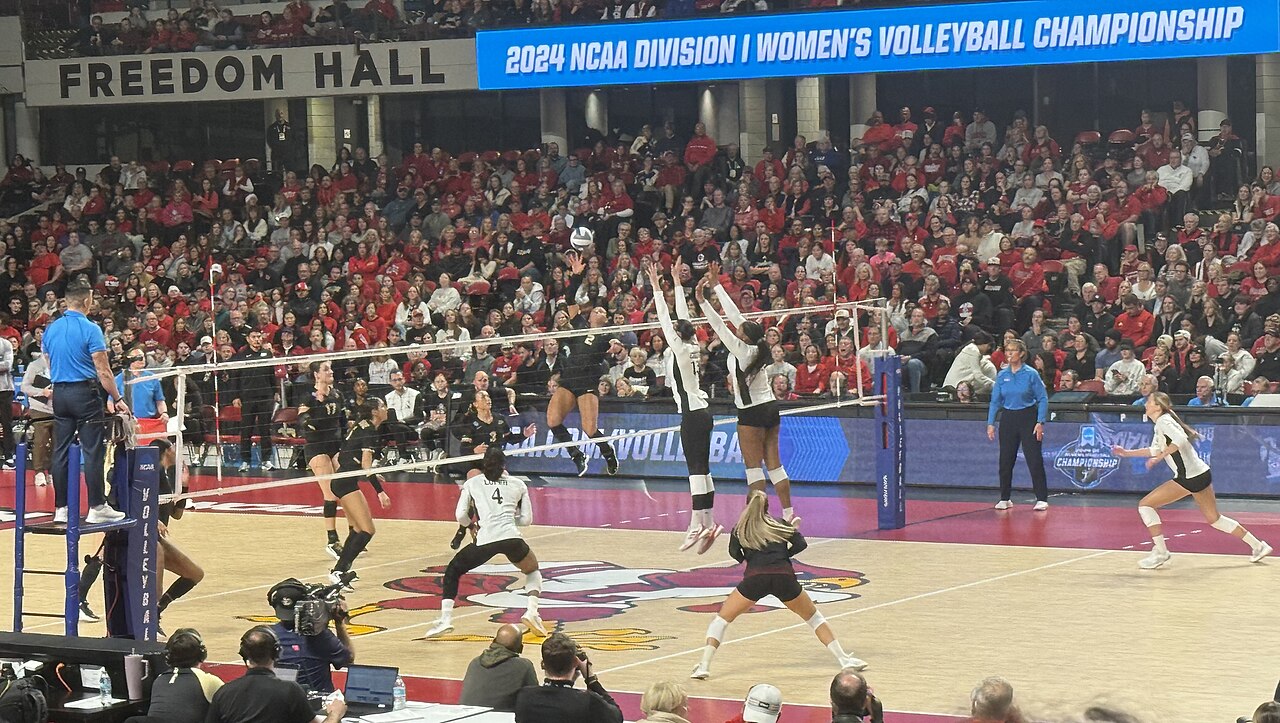
The 2026 NCAA Division I women’s volleyball tournament has 64 teams. NCAA.com’s Road to the Championship says 31 of them get in automatically as conference champions, and the other 33 are picked “on an at-large basis by the Division I Women’s Volleyball Committee.” Those 33 are the part of the bracket a committee actually chooses, and they’re what fans mean when they talk about “the bubble.”
This page explains how the committee makes those picks, using the 2026–27 NCAA prechampionship manual. It is a teaching page, not a bracket projection. We do not publish bubble odds or predicted fields, and nothing here is betting advice.
Live hubs: NCAA DI women’s volleyball RPI · Committee’s top 16 (Oct. 17) · Road to the Championship · 2026–27 prechampionship manual (PDF)
Related: Selection Sunday: what matters · Understanding RPI and résumé metrics · How seeding and hosting work · Conference tournament preview template · Big Ten Tournament explained · SEC Tournament explained · Big 12 champion explained · ACC champion explained
The short version
| Question | Answer | Source |
|---|---|---|
| How many at-large bids? | 33 of 64 (31 automatic) | NCAA.com road page |
| Who picks them? | The DI Women’s Volleyball Committee, with input from regional advisory committees | 2026–27 manual, Section 2•4 |
| Minimum record | .500 or better overall | Manual, Section 2•4 |
| Schedule rule | At least 80% of matches against Division I teams | Manual, Section 2•4 |
| Primary criteria | RPI, head-to-head, common opponents, significant wins and losses, KPI | Manual, Section 2•4 |
| Secondary criteria | Last 10 matches, availability of players, location of contest | Manual, Section 2•4 |
| When is it decided? | Committee meets Nov. 27–29; field announced Sun. Nov. 29, 6 p.m. ET on ESPN | Manual, Sections 1•3 and 2•4 |
Two doors into one bracket
Each conference with automatic-qualification privileges sends one team: its champion, decided however that league decides it. Some leagues use a tournament (the Big Ten and SEC both do in 2026). Others crown the regular-season champion (the ACC and Big 12). An automatic qualifier is in no matter its record or RPI.
Everyone else who wants in needs one of the 33 at-large spots. In practice that means the second, third and ninth-best teams in the strongest conferences, plus the occasional strong team from a smaller league that didn’t win its title.
A note on the count. The manual’s 2026 automatic-qualification list prints 32 conference names, while NCAA.com’s road page and the 2025 field announcement both say 31 automatic bids. We use NCAA.com’s 31 / 33 split here. The official number is whatever the committee’s Nov. 29 release says.
Step 1: who is even eligible
Before any metric matters, a team has to clear two bars in the manual:
- .500 or better. “To be considered during the at-large selection process, a team must have an overall won-lost record of .500 or better.” A team under .500 can still play in the tournament, but only by winning its conference’s automatic bid.
- 80% Division I. “A minimum of 80% of an institution’s matches must be played against other Division I teams in order to be eligible for consideration.”
The manual also says only best-of-five matches “played to conclusion, using rally scoring” count, and Bylaw 31.3.3.1 leaves out matches against two-year colleges, club, amateur and professional teams.
A 2026 example of the .500 bar. In NCAA.com’s RPI through games of Nov. 8, Southern California, a No. 15 national seed in 2025, sat at No. 77 with a 10–14 record. Unless that record climbs back to .500 or better, the Trojans can’t be picked at-large no matter what their RPI says, and their only route would be a Big Ten Tournament title. Records change weekly, so check the live RPI and USC’s schedule for the current number.
Step 2: the criteria the committee uses
NCAA Bylaw 31.3.3 sets three criteria for every NCAA championship: won-lost record, strength of schedule, and eligibility and availability of student-athletes. For volleyball, the committee also has approval to use these (the manual says “not necessarily in priority order”):
Primary criteria
- Rating Percentage Index (RPI). NCAA’s formula: 25% your Division I winning percentage, 50% your opponents’ winning percentage, 25% your opponents’ opponents’. Bonuses for wins over RPI top-50 teams, penalties for losses to teams ranked 288 and below. Full detail: Understanding RPI.
- Head-to-head competition.
- Results versus common opponents.
- Significant wins and losses.
- KPI, a second résumé metric the manual lists by name.
Secondary criteria (reviewed “if the evaluation of the primary criteria does not result in a decision”)
- Late-season performance: the last 10 matches.
- Eligibility and availability of student-athletes. Schools must tell the NCAA before Nov. 27 about any player who has become ineligible or unavailable.
- Location of contest: home, road or neutral.
The manual also lists “evaluative tools” the committee can look at, including road record, nonconference RPI, record against RPI 1–50 / 51–100 / 101–200 / below 200, record against other teams under consideration, and “results against teams already receiving at-large bids.” That last one tells you how the room works: teams are compared against each other as the field fills, not just ranked once.
What isn’t on the list: the AVCA coaches poll. Polls and selection answer different questions (AVCA Polls Explained).
Step 3: the timetable
From Section 2•4 of the 2026–27 manual:
| When | What happens |
|---|---|
| September–November | Regional advisory committees and the national committee hold calls about teams in each region |
| Sun. Oct. 18 | Committee’s in-season top 16 revealed (games through Oct. 17) — NCAA.com |
| Nov. 24–25 | Each regional chair confers with their advisory committee on which teams to consider |
| Before Nov. 27 | Schools report any ineligible or unavailable players |
| Sat. Nov. 28 | Deadline for conferences to report their automatic qualifiers |
| Nov. 27–29 | Committee meets to review all at-large teams and set the bracket |
| Sun. Nov. 29 | Selection show, 6 p.m. ET, ESPN |
The committee “will assume all members will participate in the tournament, if selected,” so a school that would turn down a bid has to say so beforehand.
Bid thieves: why conference tournaments matter to the bubble
The at-large count isn’t fixed in practice. It depends on who wins the automatic bids.
If the best team in a smaller league wins its tournament, that league uses one bid and the bubble is unaffected. If that team loses its tournament but still has an at-large-worthy résumé, the league can send two teams: the champion on the automatic bid and the favorite at-large. That second team takes one of the 33 spots that would otherwise go to a bubble team from a bigger conference. Fans call the surprise champion a “bid thief.”
It happened three times in 2025. Comparing NCAA.com’s list of 31 automatic qualifiers with the final bracket:
| Conference | Automatic bid | Also in at-large |
|---|---|---|
| American | Tulsa | Rice, USF |
| Conference USA | Western Kentucky | UTEP |
| Summit League | St. Thomas | South Dakota State |
Big East also sent three (Creighton automatic, Marquette and Xavier at-large), but Creighton was the regular-season power, so that’s depth rather than a steal.
What to watch in 2026. In NCAA.com’s RPI through games of Nov. 8, several teams from leagues outside the Big Ten, SEC, ACC and Big 12 sat in the top 50, among them Western Kentucky (No. 18, CUSA), Toledo (No. 22, MAC), Colorado State (No. 29, Pac-12), Dayton (No. 34, Atlantic 10) and Eastern Kentucky (No. 35, UAC; it later won the UAC Tournament). If one of them loses its conference tournament, watch whether the champion is a different team. This is a reading tip, not a prediction: RPI moves every week and the committee doesn’t release a bubble list.
The 2025 at-large field, by conference
Derived from NCAA.com’s 2025 automatic-qualifier list and final bracket. The 2025 field announcement confirms 31 automatic / 33 at-large.
| Conference | At-large bids | Total teams | At-large teams |
|---|---|---|---|
| Big 12 | 9 | 10 | Kansas, TCU, Colorado, Iowa State, Baylor, BYU, Utah, Kansas State, Arizona |
| Big Ten | 8 | 9 | Wisconsin, Purdue, Minnesota, Indiana, USC, Penn State, Michigan, UCLA |
| ACC | 6 | 7 | Pittsburgh, SMU, Louisville, Miami (Fla.), North Carolina, Georgia Tech |
| SEC | 4 | 5 | Texas, Texas A&M, Tennessee, Florida |
| American | 2 | 3 | Rice, USF |
| Big East | 2 | 3 | Marquette, Xavier |
| Conference USA | 1 | 2 | UTEP |
| Summit League | 1 | 2 | South Dakota State |
| Total | 33 |
Three lessons from that table:
- 27 of 33 at-large bids went to four conferences. That’s what a 50% opponents’ winning percentage in the RPI does: deep leagues lift everyone’s schedule.
- At-large doesn’t mean “worse.” Two of the four No. 1 national seeds in 2025, Texas and Pittsburgh, were at-large teams. Pitt was an ACC co-champion but Stanford took the league’s automatic bid on head-to-head (ACC explainer). The eventual national champion, Texas A&M, was at-large too.
- Records can be modest. The .500 floor is the only hard record rule. Several 2025 at-large teams from the big leagues finished with double-digit losses, because who you lose to matters as much as how often.
How to read your team’s chances (without a bracketology model)
- Check the floor. Is the team .500 or better, with 80% or more of its matches against Division I teams? If not, it needs the automatic bid.
- Check the RPI, and the date at the top of the table, which lags results by several days.
- List its best wins and worst losses. Wins over the RPI top 50 earn bonuses; losses to teams ranked 288 and lower cost positions.
- Look at the last 10 matches. It’s only a tiebreaker, but late collapses show up there.
- Watch the small-conference tournaments in the last two weekends of November for bid thieves.
- Wait for the show. Nov. 29, 6 p.m. ET, ESPN. The committee doesn’t publish its at-large order or its “first four out.”
Related reading
- NCAA Selection Sunday: What Matters
- Understanding Résumé Metrics in Volleyball
- How NCAA Tournament Seeding and Hosting Work
- NCAA First and Second Rounds Explained
- How to Watch the 2026 NCAA Volleyball Tournament
- AVCA Polls Explained
- Conference Tournament Preview Template
- Daily Desk
Sources
- NCAA — 2026–27 DI Women's Volleyball Prechampionship Manual (PDF) (Section 1•3 dates; Section 2•2 RPI factors, bonuses, penalties, evaluative tools; Section 2•3 bracketing pilot and AQ conference list; Section 2•4 .500 requirement, Bylaw 31.3.3.1 countable competition, Bylaw 31.3.3 criteria, primary/secondary criteria, 80% DI rule, at-large timetable, Nov. 27 eligibility notification)
- NCAA.com — Road to the Championship (2026: 64 teams, 31 automatic / 33 at-large; round dates)
- NCAA.com — DI women's volleyball RPI (through games Nov. 8, 2026, checked Nov. 14)
- NCAA.com — DI Committee's top 16 (through games Oct. 17, 2026)
- NCAA.com — Tracking all 31 automatic qualifiers, 2025
- NCAA.com — 2025 championship field announcement (31 AQ / 33 at-large; national seeds with AQs marked)
- NCAA.com — 2025 tournament bracket, schedule and scores (all 64 teams by first-round match)